
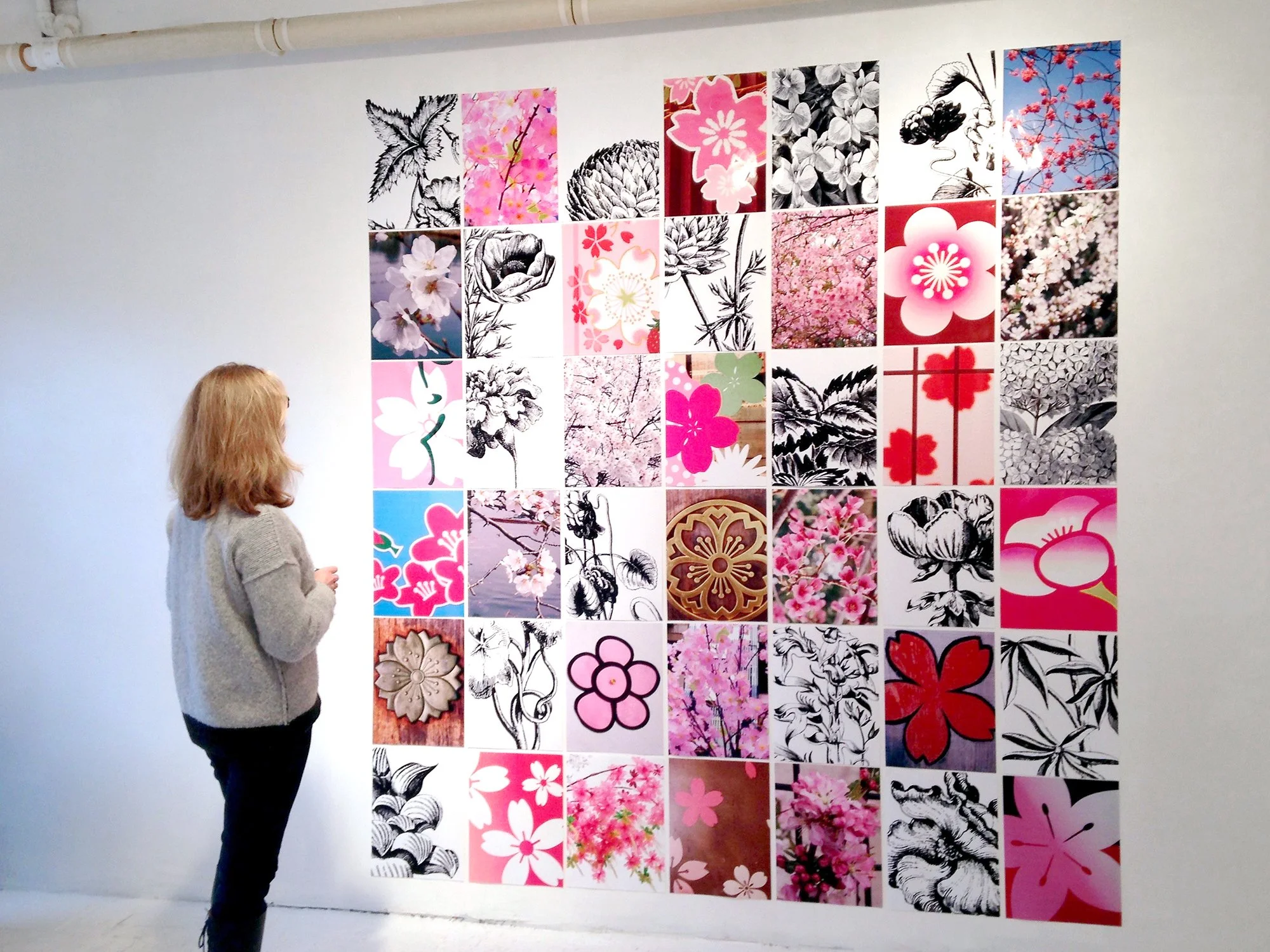
Famous Ornament | 42 images, digital ink on paper | 96” x 90" / 244 x 229 cm
Famous Ornament
In the wall installation Famous Ornament, color photographs of real, silk, and pop Japanese sakura (cherry blossoms) are juxtaposed with black-and-white digital prints of Victorian colonial botanical specimens. Through these contrasting botanical images, the work examines how plants become vehicles for both cultural celebration and national exploitation. Created during a residency at Youkubo Art Center in Tokyo, Famous Ornament also explores conflicting narratives embedded in Buddhism and Western colonialism.
In Japan, the fleeting beauty of sakura endures as a Buddhist metaphor for life's impermanence, celebrated nationally each spring with joy. Yet during World War II, Emperor Hirohito co-opted the blossoms as inspirations for annihilation and conquest. Sakura blooms adorned bomber planes, Japanese troops planted avenues of cherry trees throughout Southeast Asia, and kamikaze pilots were urged to “bloom as flowers of death” and fall like “floating sakura petals”.
A similarly conflicted history emerges in Victorian botanical drawings. While newly discovered plants inspired genuine scientific and artistic wonder, they were also collected and exported as trophy specimens for European gardens. Colonial powers and commercial nurseries used the term of “famous ornament” to frame the extraction of foreign flora as an innocent pursuit of beauty, obscuring its imperial ambitions.
In 1850, naturalist Philipp Franz von Siebold introduced Japanese knotweed to Kew Gardens as an exotic ornamental plant. It subsequently escaped cultivation and became one of Europe’s and the world’s most destructive invasive species. Like the sakura, whose beauty and symbolism was appropriated for nationalist purposes, the knotweed reveals how the celebration and circulation of botanical beauty can carry unintended and destructive consequences.


Click above images for slide show


